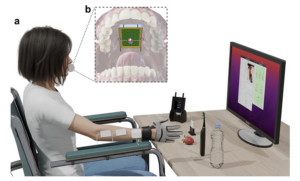
The study participant (a) wore a non-invasive tongue-control (b) to use the hand exoskeleton.
New research showed a non-invasive, tongue-controlled functional electrical stimulation (FES) system was effective in restoring hand function for study participants with cervical spinal cord injuries (SCI).
“A Tongue-Controlled FES-Robotic Exoskeleton Restores Hand Function in Users with Cervical Spinal Cord Injury” was published in npj Robotics on Oct. 8, 2026. Study authors were from Aalborg University (Denmark), the University of Twente (the Netherlands), and the Spinal Cord Injury Centre of Western Denmark.
“Hand exoskeletons and functional electrical stimulation have shown promise in restoring hand function after stroke or cervical spinal cord injury,” the study’s abstract said. “However, major challenges remain in providing reliable user command input in individuals with severe paralysis and in enabling safe and effective control of hand closing and opening.”
The tongue-based control system was used in conjunction with a hybrid soft hand exoskeleton. The participants’ tongues controlled the tendon-driven flexion of the five fingers as well as triggered finger extension via FES.
“This user-intent-driven hybrid approach supports multiple activities of daily living, such as grasping a bottle or toothbrush, and enables hand opening while mitigating muscle fatigue and reducing system complexity,” the study said.
Five study participants with cervical SCI evaluated the system and demonstrated “high task success rates in daily living tasks and user preference due to its wearability and ease of use, as well as consistently low reported levels of discomfort, pain and fatigue. These findings show that the proposed hybrid system can restore activities of daily living in individuals with cervical tetraplegia, including those with long-term injuries.”
Focusing on areas of voluntary control for high-level SCI
All five participants — two females and three males — had tetraplegia with reduced or absent motor function in their right arms. They ranged in age from 18 to 75 years old and reported being unable to repeatedly use their right hands and arms to grab a bottle with a straw from a table and drink from it while seated. Participants also reported having at least partial tongue function.
The tongue controls were enclosed in individual dental retainers created to fit the palate of each study participant. The five-finger exoskeleton was adapted from a commercial Carbonhand exoskeleton glove that originally had function in only three fingers.
Tongue control was studied as an alternative access method for people with cervical tetraplegia because they typically retain voluntary control only of body parts above the level of injury. Their injuries often limit voluntary movement to the head and neck.
“Tongue-based control interfaces (TCIs) offer reliable command-based input modality due to the availability of robust sensor technologies and the high flexibility of the tongue, which typically remains functionally intact even after high-level SCI,” the study noted.
Study participants were asked over two sessions to perform grasping tests with and without using the exoskeletons, and then filled out questionnaires about the system’s usability.
Success with comfort
Participants in the study were unable to independently grasp a bottle with their right hands, and as a group also had difficulty independently grasping smaller objects such as a business card and a strawberry.
Using the tongue-controlled system, “All five participants were able to complete the tasks with high success,” the study said. “Overall success rate for all trials performed by the participants wearing the FES opening exoskeleton was 96%.”
Via their questionnaires, participants noted that putting on and taking of the exoskeletons — with the support of a researcher — as not difficult. They gave low scores as well when asked about discomfort, pain and fatigue caused by the FES system.
Researchers noted that study participants took longer to complete the grasping tasks — 12 to 13 seconds — than a non-disabled person would, but added that participants still “indicated generally positive user acceptance of the exoskeleton with FES opening. With user training and familiarization … these times are expected to decrease.
“For all participants, tongue-controlled FES was effective in facilitating hand opening without inducing hyperextension. Even users with 20-30 years of paralysis were able to release a grasp by FES.”