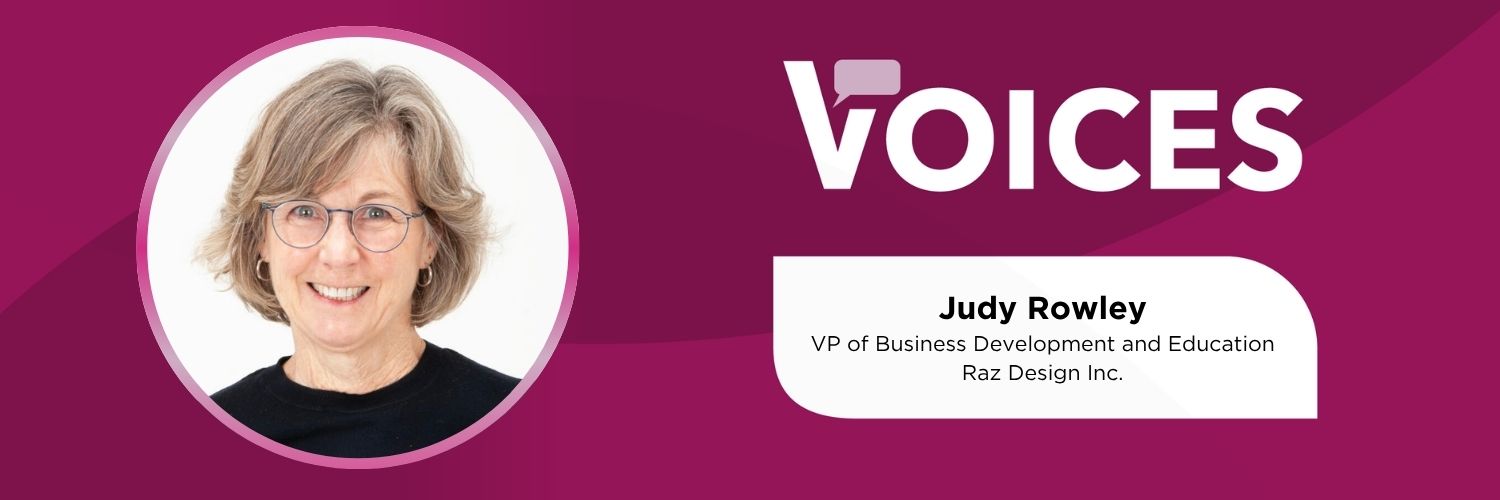
This article is sponsored by Raz Design Inc. Good mobility equipment has to do more than function. It has to hold up in demanding environments, reflect the realities of daily use, and meet needs that are often overlooked in the market. Raz Design has built its approach around that standard, with a focus on long-term durability, accessibility, and user-informed design. In this Voices interview, Judy Rowley, Vice President of Business Development and Education at Raz Design Inc., shares where shower commode chair users still face unmet needs, how end users shape product development, and what will separate the manufacturers and providers truly advancing accessibility in 2026.
Mobility Management: What perspective or experience has most shaped the way you think about mobility, accessibility and long-term equipment design?
Judy Rowley: I started my career as an occupational therapist many years ago. After working as a clinical OT for a few years, I went to work for a provider in the Toronto area, and that is where I really started to learn about equipment. We did not learn much about that in school. You really learn it on the job.
At that time, I was working with seating and mobility related to wheelchairs, along with other types of equipment like stair lifts, van conversions, walkers and other mobility products. But I became especially interested in wheelchair seating.
I started working a lot with a particular seating product line made by a Canadian company, and I really loved it. They eventually hired me to do sales and education for them, managing Ontario and the Maritime Provinces in Canada. I was with that company for 10 years, and I learned a lot from the owners as the product line grew across Canada, the U.S. and eventually around the world.
Invacare later acquired that company, and I became the product manager for seating for Invacare North America. At the time, I knew very little about the business side, but I had amazing mentors there. I spent seven years working on wheelchair seating lines and helping bring together several product lines Invacare had acquired.
Eventually, the travel became too much with little children at home, and I thought I was going to retire. That was 25 years ago. Then I was approached by the partners at Motion Concepts, which at the time was focused on power positioning. Their idea was for me to start a seating line for them, and that became the beginning of the Matrx seating line.
A year after I started with Motion Concepts, Invacare acquired the company, so I was back with Invacare again. For the last 25 years, I have really focused on wheelchair seating products, including cushions, backs, accessories and related products.
That experience has shaped how I think about mobility, accessibility and long-term equipment design because I have seen it from the clinical side, the provider side and the product side. I understand how important it is for equipment to support the person using it, but also to work in real-life settings for clinicians, providers and families.
What unmet needs still exist for shower commode chair users today?
There are a couple of unmet needs that still stand out.
One is the availability of custom-molded seating on shower commode chairs. Raz chairs have a lot of adjustability and many ways to configure the chair to support someone properly. There are also specialized seats. But for someone with more severe orthopedic issues, there are still few custom seating options that can support those individuals as well as they could be during toileting and showering.
Another need is power elevating seats for home use. There are shower commode chairs with power elevation, but right now they tend to be more institutional. They are heavy, not very compact and expensive. But you can imagine the benefit of equipment that can be raised to the right height so a caregiver can more easily help someone with bathing, toileting and their overall routine.
I think those are two key areas. Custom seating for shower commode chairs and power elevation designed for home use.
The broader point is that people often understand why someone needs to be properly supported in a wheelchair, but they may not think about showering, bathing and toileting in the same way. Some individuals can spend a couple of hours on this type of equipment because it takes that long to get through everything they need to do. If someone is not properly supported during that time, especially someone with significant mobility limitations, that can have a real impact.
That is why this equipment is such an important part of a person’s 24-hour routine and postural care management. It is a key area that needs properly fitted equipment, but it is still not always recognized that way, even by all clinicians.
What innovations in the mobility and accessibility space are you most excited about right now?
One innovation that would be very meaningful is power elevating seating for home use, which ties back to the unmet needs. That would be huge for both the person using the equipment and the caregiver supporting them.
I am also excited about tub sliders and shower sliders. Bathroom modifications can be very expensive, and if someone modifies an entire bathroom and later wants to sell the house, they may have to convert it back to a more traditional bathroom to make the home marketable again.
Tub sliders and shower sliders can allow someone to use their existing tub or shower without needing as many home modifications. That can make accessibility more practical, more affordable, and less disruptive for families.
There are also accessories that can help, including modular ramps that can support access to step-in showers. Some products are designed specifically to help people continue using their existing showers more safely. To me, that kind of innovation is exciting because it makes accessibility more realistic in the home setting.
How do end users influence the way your products are designed and improved?
End users are the key. Listening to them over the years is what helped us recognize the need for better bathing equipment in the first place. As products are developed, their feedback continues to be essential because it shows us where the products still need to evolve.
Raz has been around for about 22 years now. In the beginning, there were people who did not even think it would be a viable business because there was not much funding for that type of equipment. But the principals who started Raz had a strong conviction that there was an unmet need. They had years of experience in the industry as providers, so they understood what people were actually dealing with and where existing products were falling short.
That is also what made me want to invest in the company 22 years ago. I believed in the vision they had. There was a real unmet need, and I knew we could do a better job than what was available at the time.
What led me to make this move at this stage of my career is that Raz has developed an amazing line of bathing equipment. It is recognized as one of the best in the world, with strong options across many different types of equipment. But the product line never stops evolving.
One thing the team often says is that they learn the most from end users when those users tell them what they do not like about what they have. Years ago, there was a lot that people did not like because there was not much available that was truly rehab-focused bathing equipment. Even today, we continue to develop and improve the product line based on feedback from end users, clinicians and caregivers.
That includes things like the elevating seat, where caregiver strain and back problems are part of the need. It all comes back to listening to the different customer groups and using that feedback to keep improving the equipment.
What goes into designing a shower commode chair that can hold up for years in demanding environments?
A lot of it starts with material selection. When a product has to survive in a wet environment, materials are really important.
Plastic is used a lot, but plastic does not always have a long lifespan. It can break down over time. Stainless steel and properly treated coated aluminum are much better suited to hold up in that environment, and that is key for a product that may be used every day, sometimes multiple times a day.
Raz also does a lot of torture testing that goes beyond standard RESNA testing. That includes accelerated life testing, where the team simulates years of use to understand how the product will perform over time. The product is really tested hard.
Another important piece is the quality of the casters. Casters can be a weak point on a shower chair, and there is a big difference between lower-quality offshore casters and high-quality casters. The casters we use in the Raz product line are U.S.-made, and that matters for durability.
But durability is not only about whether the chair lasts. It is also about whether it supports the person properly and remains comfortable over long periods of use. Some people may sit on this equipment for a couple of hours during their bathing and toileting routine. If the seat is uncomfortable, poorly shaped or not adjustable enough, that can create discomfort and even contribute to pressure-related problems.
So the adjustability, the shape of the seat, the materials and the overall quality of the components all matter. That is what sets Raz products apart. They are built for the realities of daily use, and they are recognized as one of the best product lines in the world for this type of equipment.
What barriers still prevent people from accessing the bathing and toileting equipment that best meets their needs?
To be honest, I think the number one barrier is still education. It starts with making sure the clinicians who prescribe this equipment understand how important it is and know how to direct the end user to the most appropriate product for their needs.
That is a big part of my role at Raz. My title is Vice President of Business Development and Education, and I am putting together an education team. This week, I am finalizing the hiring of two U.S. therapists to serve as educators for Raz. We are also adding another educator in South America, and I am speaking with someone in Europe as well.
Education is number one, and what follows education is funding. Funders also need to understand the value of this equipment so people can actually access it. Those two things go hand in hand. Clinicians need to understand what is possible, and funders need to understand why the right equipment matters.
Looking ahead, what will separate the manufacturers and providers that truly advance accessibility in 2026 from those that continue to fall short of user needs?
I think it will come down to the number of happy, satisfied customers they have. That is what will help manufacturers and providers grow their businesses in the long run. A happy customer can become a lifetime customer.
For providers, imagine giving someone a shower chair when they may have been using one that was not very good, or not properly suited to their needs. Then they receive a product that really works for them. That can make a huge difference.
We hear feedback from end users who say this type of equipment changed their lives. That is what advancing accessibility should really mean. It is not only about building or providing a product. It is about whether that product genuinely improves the daily life of the person using it.
Some of that can be measured quantitatively, but a lot of it is also qualitative. You can sense it when the product is making a difference and when the customer feels supported. Nothing feels better than making a difference in the life of an end user. Nothing is better than that.
Editor’s note: This interview has been edited for length and clarity.
Raz Design Inc. provides configurable mobile shower commode chair solutions, focused on comfort, safety and function. Our chairs support users from pediatrics to bariatrics, along with 24 standard seat options plus custom configurations.
Please visit us at https://razdesigninc.com/ for more info.
The Voices Series is a sponsored content program featuring leading executives discussing trends, topics and more shaping their industry in a question-and-answer format. For more information on Voices, please contact [email protected].