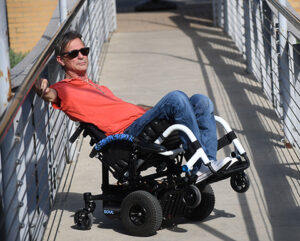
Power-Flex inventor Todd Hargroder using the system’s posterior tilt function.
Todd Hargroder will tell you his inventions — from the transfer board he created that started his rehab engineering career to the paradigm-shifting Power-Flex power-drive attachment for lightweight manual wheelchairs — were born of his own observations, goals and needs as a longtime ultralightweight wheelchair rider.
But along the way, his innovations have transformed many lives beyond his own. Power-Flex, sold by SOUL Mobility, which Hargroder cofounded with Troy Tesmer, answers the most complex question so far: What happens when decades of self-propelling collide with the natural aging process … not to mention with terrain and long distances?
A new type of power wheelchair
Hargroder has been a wheelchair rider for 40 years, since sustaining a high-level spinal cord injury in a motorcycle accident in 1986. In 1993, he founded Accessible Designs Inc. (ADI), known for evolutionary components such as wheelchair disc brakes and carbon fiber back supports. Hargroder sold ADI to Stealth Products in 2015.
But he kept inventing and sharing his perspectives and expertise. Over the years, Hargroder has served as an adjunct faculty member at the University of Pittsburgh’s Department of Rehabilitation Science and Technology and has co-instructed the assistive technology design course for the school’s master’s in rehabilitation technology program.
And just a few years after selling ADI, Hargroder cofounded SOUL Mobility to address a question facing so many other people aging with spinal cord disabilities: What happens when many years of pushing wears down shoulders, arms, wrists and hands?
Over the last many years, the most common answer has been power-assist, a system that attaches to the front, back or underside of an ultralightweight wheelchair or is incorporated into the wheel hub of manual wheelchairs. Power assist has seen dramatic expansion in recent years, giving wheelchair riders more options than ever.
And yet, Hargroder saw a gap in functionality. His answer: Power-Flex, which attaches to a lightweight manual wheelchair (after it sheds its wheels) to create a power chair with a compact footprint, low seat-to-floor height, suspension, and rider-activated manual tilt.
The conversion from manual to power or vice versa takes 30 seconds and is tool free. The resulting SOUL Mobility power chair provides repositioning for pressure relief (and to lift the front casters over obstacles), a joystick driving control, 10-inch solid drive tires, and “handrims” in the same location as the manual wheelchairs to help support weight shifts, position changes and transfers.
“With traditional power assist, it’s a straight-line propulsion only,” Hargroder said in explaining the differences. “And you have your hub drives, you have your SmartDrives under the chair, and so forth. But with it all said, it’s not a one-size-fits-all. Some people need that 30-pound lightweight option to go straight. Versus our system has suspension in addition to manual tilt. So it really converts our lightweight manual chairs — our K0004, K0005 manual chairs — to a lightweight compact power chair with suspension and manual tilt features, giving manual wheelchair riders the option of a power assist that is straight-line propulsion only or a true lightweight power chair.”
Retaining the familiar
 Hargroder said he’d built a few power wheelchairs back in the ADI days as “side projects” — and kept running into the same seat-to-floor height problem.
“I can’t fit under my desk,” he recalled of those earlier hand-built power chairs. “I can get in this chair and go outside, but then when I want to come back into my environment, I can’t fit anymore. So I learned quickly through those couple of iterations about the importance of a compact size, and how much I built my world around my chair ride height, my desk, my sink, my tables at a normal height. As best as possible, we have to integrate into the real world, and not wait for the world to integrate into ours.”
Despite the challenges, Hargroder noted that his own experiences affirmed the need for a better solution.
“I pushed for a long time, but it got harder and harder,” he said of his ultralightweight chairs. At the same time, he knew firsthand how accustomed wheelchair riders get to every nuance of their mobility devices.
So the Power-Flex retains the handrims that riders use to help with transfers and repositioning. It also maintains the manual wheelchair’s ride height and seating configuration.
After years of side-project power chairs, Hargroder said Power-Flex brings power and manual mobility together, “maintaining those exact seating angles and footprint of my manual chair and feel and function and so forth. You drive the Power-Flex differently than you would a large power chair. You drive it more like a manual chair, and it’s certainly different than what’s out there. But my needs certainly have driven the design of this product.”
Added functionality in a compact footprint
 Hargroder said he was aiming for a “seamless transition” between the Power-Flex and the original manual wheelchair, because Power-Flex riders have the option to change back and forth depending on environment and tasks.
“It feels exactly like the manual chair,” he said. “That’s important in crowds and department stores and grocery stores and all these other places. But in the home, it makes a huge difference when you’re in small places like a bathroom or closet and can go in there and turn around on a dime, and do a complete 360 right here.”
As for Power-Flex’s 30 degrees of manual posterior tilt, Hargroder said, “I’ve been leaning back on things for many, many years because of just sitting upright all day long. It’s very tiring, and I realize how much I built up my neck and how much my neck is a big part of my balance point. And to be able to lean back and just take a load off throughout the day is much easier in this than even when I did it in my manual chair.”
The Power-Flex is so nimble that Hargroder said he’s able to “go directly on the plane and go into the galley and then back up to the front seat if bulkhead’s available. We can go to the first seat, transfer over, unlock the motors, and then they just roll it right down to the storage. The overall height is low enough that [baggage handlers] just lift it up on the conveyor and it goes right into the belly of the plane.”
And yes, Hargroder and the SOUL Mobility team are still looking forward. He said, “We’re working on new accessories, and we’re excited to get the word out of a new product category, hybrid mobility. This is really just the beginning of where we plan to go to fill that gap between our lightweight manual wheelchairs and large dedicated power chairs.”