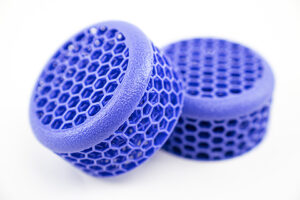
Examples of Carbon-produced lattices.
Traditionally, seat cushions that provide the most help for wheelchair riders — such as custom-molded ones with robust support and positioning, or that accommodate asymmetrical or windswept postures — have come with tradeoffs. They can be bulky and heavy. They don’t breathe well, so they trap and hold heat. They also trap and hold moisture, which can cause skin maceration and raise pressure injury risk. On the manufacturing end, they can also be costly and time consuming to produce.
Could 3D printing — used by many other industries, but still feeling a bit futuristic even decades after its invention — offer another option?
What is 3D printing?
Based in Redwood City, California, Carbon is a 3D-printing technology company working in the automotive, industrial, medtech, and consumer industries — the last of which includes bicycle seats, baseball gloves, helmets (for cyclists, football players, hockey players, members of the military), and midsoles for athletic shoes. Even if you don’t know Carbon’s name, you know its partners: Adidas, A$AP Rocky + Puma, Rawlings, Riddell. In the automotive space, Carbon has worked with Ford Motor Company on HVAC parts and Ford Mustang GT500 electric parking brake brackets, and with Lamborghini on a textured fuel cap and clip components for an SUV air duct.
Now, Carbon is taking its talents to the custom wheelchair seating market, where precision can make the difference between a wheelchair rider’s functional success or failure.
Emily Rose Williams, Carbon’s business development director, brings with her a degree in mechanical engineering from the University of Texas at Austin. She’s spent the last two years studying the wheelchair cushion industry.
“We make the printers,” she said in explaining Carbon’s business. “We make the software to design the lattice.”
A lattice is the 3D structure made of interlocking, repeating cells that get printed. Imagine Lego blocks as cells, and a bunch of Lego blocks snapped together as a Lego lattice.
“I would say we are a materials company first and foremost that also makes printers to print the materials, and software to design the parts to make with our materials,” Williams said.
She then explained the different ways to 3D print: “There’s FDM [fused deposition modeling] printing, which is an extruded melted plastic. There’s SLA [stereolithography], which is a laser-based system: A laser cures the resin.”
Carbon, however, uses digital light synthesis: “A UV light cures an entire slice at a time to set the shape of a part. And then we take that part and put it through a thermal cure. So it’s a two-part system, which is different than a lot of the other 3D-printing methods out there.”
The process, Williams added, “really allows for final end-use mechanical properties and more durable polyurethane chemistries. You can think about it as the part growing out of the vat of resin because the platform’s kind of lifting as the part is printing. The parts lift out of this liquid resin, and it is a layer-based process. Each layer cures to the layer beneath it, and you don’t have any issues with layer strength. Sometimes in an FDM system, for instance, there are pretty stark differences between layers. So if you were to have impact on the side of a part, you’d have some weakness at those layer points.”
3D printing and the demands of wheelchair seating
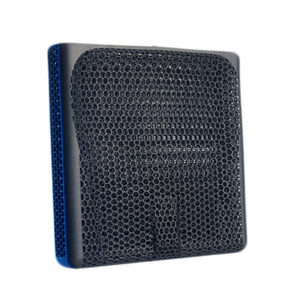
A Carbon 3D-printed seat cushion.
Carbon’s technology and processes are already producing “millions of custom parts every year,” Williams said.
Footwear, bicycle saddles, and helmets made using Carbon’s technology have significant similarities to wheelchair seating, Williams said. “Adidas has printed several million pairs of midsoles for their 4D line,” she pointed out. “I think we’ve got 20-plus saddles on the market today, some of which are fully custom. A rider would come in, sit on the saddle pressure map, and then we can adjust the lattice within the saddle for that user specifically.”
Bike saddles — which bear and distribute weight as wheelchair seating does — “are custom lattices based on a pressure map,” Williams said. “Helmets will be custom shapes based on scans and shape captures of the players’ heads. So you can imagine in the cushion space, we could do a custom shape and a custom lattice based on a pressure map.”
The ability to create lattices per application gives 3D printing technicians the ability to, for example, provide impact protection in a helmet exactly where it’s needed most. “You can vary the lattice based on where it is on the helmet, but also, the lattice can change throughout the width of that pad. With foam, you’re very limited to a single density. Or you can have multiple foams stacked together — a comfort layer, and then an impact layer.” Carbon’s technology, in contrast, “can be seamless,” Williams said. As for the lattice structures, “they can be tailored for whatever that user is looking for and whatever they need.”
What could 3D printing do for molded seating applications?
Carbon’s first ventures into seating have focused on ultralightweight wheelchairs. But given the abilities of 3D printing, it’s easy to envision the general technology also producing custom-molded seating.
“We could print a custom cushion in roughly six to eight hours,” Williams said. “Of course, it depends on the size and the shape. But the other thing that’s nice about 3D printing is that it’s quite scalable. You could easily have multiple printers going at one time, and you’re only using what you need for that cushion. You don’t have any waste.”
Williams added that there could be “some flexibility on the lattice structure. So instead of just doing a single lattice throughout the entire cushion to mimic single-density foam, you could have the user pressure map on whatever they’re using to take the shape capture. You could have them pressure map and then add features into the lattice — like wells in the IT [ischial tuberosity] zones or in different areas where you might want a stiffer backrest. You can add that into the design before the part is printed, and essentially have dual density or as many zones of density as you want in a single printed cushion.”
In seating clinic, a clinician could input a scan file and a file of the client’s pressure map. 3D printing technology such as Carbon’s would create the seat cushion based on additional parameters from the clinician, such as seat width and depth.
“It would slice and dice how you wanted it to, and then it could automatically populate based on the pressure map,” Williams said.
How 3D printing could fit into seating provision
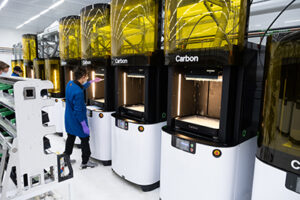
Carbon’s 3D-printing manufacturing process in action.
While Williams said she and the Carbon team are still learning about complex seating, she added, “A lot of the clinics I’ve talked to are limited in the number of patients they can see because of all the time they spend with the patient on the front end of the design, or on the back end, with the hand carving and things like that. We can really cut down on that design time because we have automated processes. And of course, we provide different check stops. You can set it up however you want with different go/no-go stops — like, does this look OK, or do you want to adjust anything based on feedback from the patient? You can intercept it at any point, but it does allow for a really quick turnaround of custom parts.” A typical turnaround time for a Carbon-printed custom bike saddle, for example, is two to four weeks.
But clinicians and providers “wouldn’t necessarily need to bring in a printer to do the printing themselves,” Williams said. “They could outsource from a nearby [vendor] that has, for example, 10 printers available. So they wouldn’t be limited to just the time they have on their printer. We’ve got production partners that have the capacity of multiple printers. They buy resin in large quantities, so they get pricing at scale.”
Carbon doesn’t do the manufacturing itself, but as it expands into new industries, “We like to work with new customers and help them find the right partner,” Williams said. “We’ve got partners that are fantastic at making bike saddles. We’ve got partners that are fantastic at making running shoes. We’ve got partners that are FDA ISO 13485 certified for medical device production. And that’s where we would likely send customers or clinicians who are looking to make cushions.”
Eventually, Carbon hopes to have regional 3D printing partners who are the go-to specialists for wheelchair seating. “But right now, we’re taking the inbound requests,” Williams said, and matching those requests with printing providers.
So while a seating clinic could buy a 3D printer, hire or train someone to operate it, and renovate its facility to accommodate the equipment, the 3D printing industry has additional options.
“We found that it works better when we have manufacturers that know what they’re doing and do this every day,” Williams said. “They have better lead times, better material pricing, better margins.”
Otherwise, a seating clinic might need to print 500 cushions a year to justify buying its own 3D printer. “I would always recommend that customers go to a partner first and get started there,” Williams said. “It’s really easy to ramp up with someone that already has a printer. No learning curve.”
Is 3D printing right for complex seating?
Functionally, is a 3D-printed seat cushion going to perform as well as a cushion constructed of foam, gel or air cells?
In true Complex Rehab Technology fashion, Williams said, “My answer is always going to be ‘It depends.’ Sometimes, data does not equal actual feedback from patients or users. It’s been such a learning experience for me to say, ‘Well, the pressure map looks good,’ but they don’t think it feels as good, or they like their old foam cushion that pressure maps way worse [than the 3D-printed one].’”
On a more objective level, though, Williams compared the resin in 3D printing to, for example, the durability of foam.
“There are thousands of foams out there, and there are some super-durable foams,” she said. “But what we found is that the more durable the foam, likely the heavier it is. When you’re dealing with a high-density foam, you have the whole [cushion] made out of foam. We have a similar chemistry to a high-density polyurethane foam, but when you’re printing a lattice structure, you don’t have to fill it up 100% with this material. So, if we were to just print a slab of our material versus a slab of foam, obviously we’re going to be as heavy or heavier than that foam. Whereas, if you’ve seen our lattices, the structure of them makes them lighter than foam cushions. ”
In addition to using less material and being lighter in weight, the lattice structure’s breathability, Williams said, is one of its greatest advantages.
“Especially in the cushion market, having enhanced airflow and microclimate management is our true benefit,” Williams said. “So we could be the same weight and the same durability, but you can feel the airflow as you’re sitting on it. You can feel it cooling, pulling heat away from the body much better. Moisture retention is much, much less because any moisture can just flow through the lattice structure. As far as density versus durability: We can have a lot less material actually being used, and the durability is very good.”
Even when completely wet, the lattice doesn’t soak up water — Williams said you can tap it a few times to shed whatever water is clinging to it, and the cushion would then be dry.
“I’ve heard from a lot of very active users,” Williams said. “They want to go to the pool. Or they’re traveling and they want to take their cushion into the shower; they don’t want to sit on a hard surface in the shower. You could take your [3D-printed] cushion off the chair and know it’ll be dry in a matter of minutes. You could never do that with foam. On the flip side, if you have some sort of incontinence cover so moisture isn’t soaking [into the foam], then you’re going to be sitting in a pool of liquid [on top of the cover].
“It’s the same with gel cushions and air cushions; they’re inherently not breathable because of what they’re made out of. I see our materials being able to solve for all of that.”
Cushions made using Carbon’s technology don’t need maintenance, and while they do get slightly warmer or cooler according to ambient temperatures, Williams said Carbon has tested the cushions in very high and low temperatures without seeing any detrimental effects. “You can imagine using a running shoe in all climates,” Williams said. “Those are pretty similar climates you might imagine for a cushion.”
As for sizing, Williams said, “Small is easy. Where we are limited in build area is when we get large [sizes].” She declined to go into specific strategies beyond saying that Carbon is working on ways to build cushions with widths greater than 16×18 inches.
Busting 3D printing myths
While 3D printing still might sound like sci-fi to some, Carbon is proof of the technology’s real-world abilities. In fact, Carbon’s website recently got a refresh that added a section on the company’s wheelchair cushion capabilities.
“I would say the biggest misconception about 3D printing is that it’s not ready for end-use products,” Williams said. “We’re fighting this battle every day — ‘Oh, my kid has a 3D printer in their garage.’ You could never print a durable cushion with that. We’re not like other 3D printers; I would say our competition is foam manufacturing and injection molding. But we are making end-use parts. They are durable. They last a long time. They are cost effective. Consumer companies wouldn’t be putting our products in their equipment if it didn’t make sense from a margin perspective.
“My day-to-day is just convincing people that 3D printing is effective and affordable. And we’re willing to try anything, if anyone has any ideas they want to test out.”
Images courtesy Carbon.