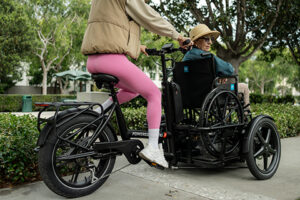
 Transportation can be a complex and common concern for wheelchair riders, their families and caregivers. While power wheelchair transportation tends to make headlines in the Complex Rehab Technology world, transportation over longer distances is also challenging for manual wheelchair riders, particularly those who don’t use power-assist systems.
Ferla Family Bikes has a long and wide-ranging history of making it easier for families (and their cargo) to get around. Its parent company, Ferla Bikes, has been in the business of commercial bike carts — mobile stands for vendors selling coffee, baked goods, ice cream — for the last decade. The Family Bikes division, as its name implies, focuses on transporting people, big and small, plus their gear and pets.
And now, Ferla Family Bikes, based in Gardena, California, is offering the Ferla Wheelchair Bike, capable of transporting manual and smaller power wheelchairs plus their riders.
Inessa Halatyan, Ferla Family Bikes’ marketing and sales director, told Mobility Management, “The Ferla Wheelchair Bike was designed for individuals with limited mobility who use manual wheelchairs and many standard power wheelchairs. Our customers include families, caregivers, senior living communities, rehabilitation centers, hospitals, municipalities, universities, parks and organizations looking to make transportation more accessible.”
While not designed for off-roading or uneven terrain, the Wheelchair Bike can navigate paved roads, sidewalks, bike paths, parks, campuses, residential neighborhoods “and other maintained urban or suburban environments,” Halatyan said. “It handles everyday transportation and is ideal for assisted living communities, hospitals, universities, resorts and public parks.”
A new take on longer distances
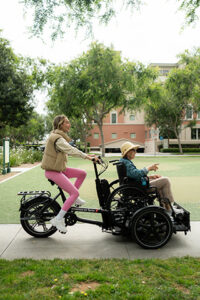 Larger environments have always challenged the strength and stamina of riders or caregivers who self propel or push manual chairs. And power chairs can burn precious battery range crisscrossing those longer distances.
Now imagine a way to transport riders and their wheelchairs more efficiently, and less expensively than by car or ramp-equipped wheelchair-accessible vehicles.
“Our goal was to create a transportation solution that restores freedom of movement,” Halatyan said. “The Wheelchair Bike allows users to remain comfortably in their own wheelchair while traveling safely and efficiently over longer distances. It is equally valuable for recreational rides, daily transportation, medical campuses, assisted living communities, parks, universities, and municipalities.”
The call for such a solution “came directly from our customers,” she added. “As Ferla grew, our cargo bikes introduced us to hundreds of families, caregivers and organizations. We began receiving frequent requests for an accessible transportation solution for wheelchair users. While we could adapt some of our existing bikes, we realized we weren’t truly solving the problem.
“Instead of modifying a cargo bike, we chose to build a purpose-designed product from the ground up, one that prioritizes accessibility, safety, comfort and independence. That’s how the Ferla Wheelchair Bike came to life.”
The current model — with a total hauling capacity of 465 lbs. (211 kg) and maximum driver weight of 265 lbs. (120 kg) — is “optimized for manual wheelchairs and many standard power wheelchairs that fall within the vehicle’s size and weight specifications,” Halatyan said. “This allows us to maintain excellent stability, braking performance, maneuverability and overall rider safety. As with all Ferla products, we continuously listen to customer feedback. We are always exploring future innovations and improvements, including ways to expand our accessibility solutions as technology and engineering evolve.”
The Wheelchair Bike features a tilted, foldable ramp; wheelchair docking on the platform; and a 1000W electric assist with reverse gear. Steer-able front wheels shorten the bike’s turning radius and provide added stability, the company says.
Ferla sells the Wheelchair Bike directly to customers in North America, but is “also working with a growing network of dealers and commercial partners,” Halatyan added. “We’re always interested in partnering with qualified mobility dealers, rehabilitation specialists, healthcare organizations, municipalities and distributors who share our vision of making accessible transportation available to more communities.”
Images courtesy Ferla Family Bikes.